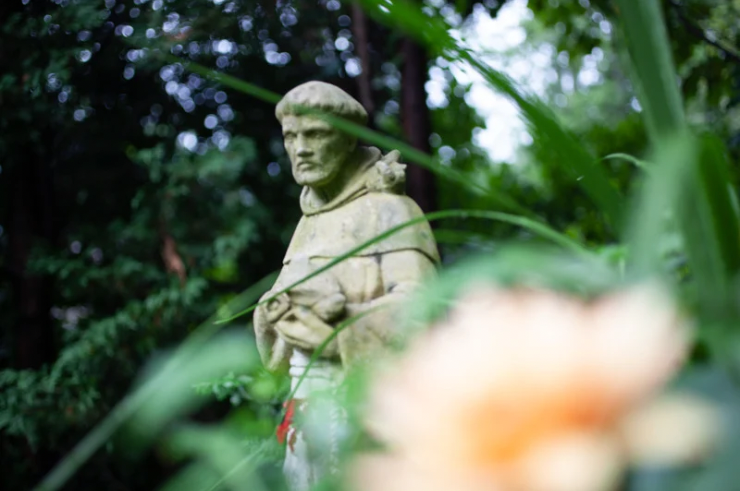
Eight hundred years ago, St. Francis of Assisi died in a small chapel in Italy.
By then, his life had already changed the Church. He had given up wealth for a life of poverty. He cared for people others avoided. He preached the Gospel and called people back to Christ.
But there is another part of his story that many Catholics may not know.
St. Francis went to the Holy Land.
He traveled into a region torn apart by war. He crossed enemy lines during the Crusades and met with a Muslim sultan. His desire to follow Christ eventually helped inspire a Franciscan presence in the lands of the Bible that continues today.
That makes 2026 more than an anniversary.
It is a chance to look back at St. Francis 800 years after his death and discover why his connection to the Holy Land still matters.
Why 2026 is a special year for St. Francis
St. Francis died on Oct. 3, 1226, at the age of 44. His feast day is celebrated each year on Oct. 4.
This year is different.
The Church is marking the 800th anniversary of his death. Pope Leo XIV proclaimed a special Year of St. Francis from Jan. 10, 2026, through Jan. 10, 2027.
In announcing the special year, the Church called Catholics to follow the example of St. Francis and become witnesses of peace.
That message has deep roots in the life of Francis.
He lived at a time of violence and division. War between Christians and Muslims had continued for generations. Yet Francis believed the Gospel called him to go beyond the world he knew.
That calling eventually took him across the Mediterranean.
Why did St. Francis go to the Holy Land?
To understand the story, we have to go back to 1219.
The Fifth Crusade was underway. Christian forces had attacked the Egyptian port city of Damietta. Muslim forces defended the region under Sultan al-Malik al-Kamil.
Francis arrived in the middle of the conflict.
He did not come as a soldier.
He came as a friar.
Francis wanted to share his Christian faith. He also had a deep love for the places connected to the life of Jesus.
The Holy Land was not an idea to Francis. It was the land where Christ had been born. It was where Jesus taught his disciples and gave his life on the cross.
Francis wanted to be close to those places.
But first, he would have to pass through a war.
St. Francis and the sultan
What happened next remains one of the most remarkable events in the life of St. Francis.
Francis crossed the battle lines with another friar and entered Muslim territory. He eventually came before Sultan al-Malik al-Kamil.
Consider how unusual that was.
A Christian friar stood before a Muslim ruler while Christian and Muslim armies were at war nearby.
Francis could have been imprisoned or killed.
Instead, the sultan received him.
Historical accounts differ on some details of their conversation. We know Francis spoke openly about his Christian faith. We also know the meeting ended peacefully.
Francis was allowed to leave.
The two men did not end the Crusades. They did not erase the differences between Christianity and Islam.
But they met face to face.
In an age when enemies often met on a battlefield, Francis chose a different path.
More than 800 years later, that moment still speaks to a world divided by conflict.
Francis reaches the lands of Christ
The Franciscan mission in the region had already begun. Friars had been sent across the Mediterranean before Francis made his own trip.
Francis traveled to the region in 1219 and 1220. Tradition holds that his time there included Egypt, Syria and Palestine.
For Francis, being near the places of Christ was deeply personal.
His faith centered on Jesus becoming man and entering human history. Bethlehem was a real place where Christ was born. Jerusalem was where Jesus suffered, died and rose from the dead.
Those places mattered because of what happened there.
That love for the physical places of our faith became part of the Franciscan mission.
And the friars stayed.
Why are Franciscans still in the Holy Land?
More than a century after Francis made his journey, the Church formally entrusted the Franciscans with the care of holy places in the region.
In 1342, Pope Clement VI recognized the Franciscans’ role in caring for Christian holy sites.
Their presence continued through centuries of change.
The friars have cared for places connected to the life of Christ. They have welcomed pilgrims who travel thousands of miles to walk where Jesus walked.
But their mission has never been only about buildings.
The Holy Land is home to people, too.
Christians have lived there since the earliest days of the Church. They worship in its churches and raise their families there.
They are often called the “living stones” of the Holy Land.
That distinction is important.
Without Christian people, the Holy Land could become a collection of places where Christianity once existed.
The Christian faith was never meant to exist only in history.
It is meant to be lived.
The living stones of the Holy Land
Today, Christian families in the Holy Land face challenges St. Francis could not have imagined.
Yet one question has remained through the centuries.
Will Christians be able to remain in the land where Christianity began?
For many families, staying is not a simple choice.
Young people need an education that can lead to a career. Parents need a way to support their children. Families need a reason to believe they can build a future at home.
When those opportunities disappear, leaving can become the only realistic option.
Each family that leaves makes the Christian community smaller.
This is why preserving the Christian presence in the Holy Land requires more than protecting historic churches.
It requires supporting the Christians who still call the Holy Land home.
An 800-year-old mission that is still alive
The Franciscan Foundation for the Holy Land works alongside the Franciscan mission to help Christians remain in the land of their faith.
Education has become an important part of that work.
Through university scholarships, Christian students can prepare for careers that give them a future in the Holy Land.
Other programs help children and families who face difficult circumstances.
The goal is not simply to remember the Christian history of the Holy Land.
It is to help that history continue.
That idea connects directly to the Franciscan presence that began more than eight centuries ago.
St. Francis crossed the Mediterranean because the land of Christ mattered to him.
Today, Franciscans continue to serve there because the people of that land matter, too.
What would St. Francis recognize today?
The world St. Francis entered in 1219 was deeply divided.
The Holy Land and surrounding region had been shaped by years of conflict. Fear separated people. The future was uncertain.
More than eight centuries later, some of those realities sound familiar.
St. Francis did not have an easy answer for the conflict of his time.
He did something much simpler.
He showed up.
He crossed a line others would not cross. He remained faithful to Christ in the middle of conflict. His example helped begin a Franciscan presence that has endured for more than 800 years.
Pope Leo XIV has pointed to that example during this anniversary year. In a letter marking the 800th anniversary of Francis’ death, he expressed hope that the saint’s message of peace would find a new place in the Church and the world.
That message carries special meaning in the Holy Land today.
The Christian presence there has survived war and hardship. It has endured for generations because people have chosen to stay.
Franciscans have stayed with them.
Eight hundred years later
St. Francis died far from the Holy Land on Oct. 3, 1226.
But part of his legacy remained there.
It can still be found in the Franciscan friars who serve at the holy places.
It can also be found in Christian families who continue to call the Holy Land home.
Eight hundred years after the death of St. Francis, Catholics have an opportunity to look beyond the familiar image of the humble friar from Assisi.
His story also belongs to the Holy Land.
And that story is still being written.
Help Keep the Christian Presence Alive
For more than 800 years, Franciscans have remained committed to the Christians of the Holy Land. You can be part of that continuing mission. Your support helps Christian families build a future in the land where our faith began.